
The possibility of a child being taken overseas without consent is extremely distressing for any parent. For separated families, international travel can raise serious concerns, particularly where there is limited trust between parents or uncertainty about whether a child will be returned.
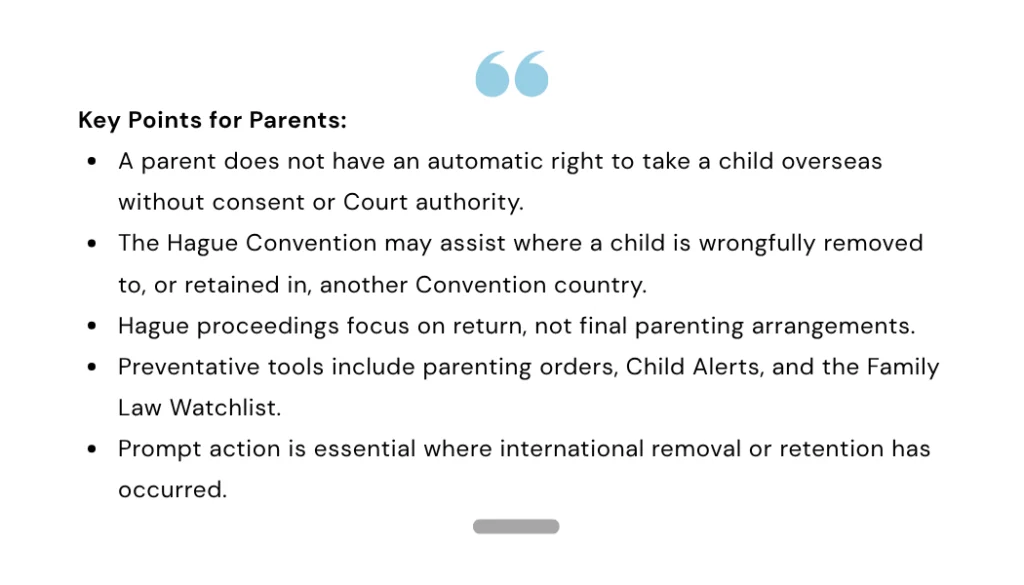
Australian family law treats international child removal and retention seriously. Where a child is taken from, or kept outside, their country of usual residence without proper consent or authority, the Hague Convention on the Civil Aspects of International Child Abduction may apply.
In Australia, the Hague Convention operates through the Family Law (Child Abduction Convention) Regulations 1986 (Cth).
When Is International Child Removal “Wrongful”?
A child’s removal or retention may be considered wrongful where:
- the child was habitually resident in Australia, or another Hague Convention country, immediately before the removal or retention;
- the removal or retention breached another person’s rights of custody under the law of that country; and
- those custody rights were being exercised at the relevant time.
“Retention” can occur even where overseas travel was initially agreed. For example, if one parent consents to a short holiday but the other parent refuses to return the child as agreed, this may amount to wrongful retention.
The Hague Convention generally applies between countries that are parties to the Convention and to children under 16 years of age.
How Hague Convention Proceedings Work
Hague Convention matters are different from ordinary parenting disputes.
The Court is not usually deciding who the child should live with in the long term. Instead, the key issue is whether the child should be returned to their country of habitual residence so that parenting issues can be determined there.
The Convention is designed to discourage international forum shopping and ensure that parenting decisions are made by the courts in the country where the child ordinarily lives.
The Role of the Australian Central Authority
The Attorney-General’s Department is Australia’s Central Authority for Hague Convention matters. It works with overseas authorities and assists with applications involving the return of children between Convention countries.
Where a child has been taken to a Hague Convention country, the Central Authority process is often an important pathway for seeking the child’s return.
When Can a Court Refuse Return?
The Hague Convention aims for the prompt return of children who have been wrongfully removed or retained. However, there are limited exceptions.
A Court may refuse to order return in circumstances including where:
- there is a grave risk that return would expose the child to physical or psychological harm;
- the child objects to return and has sufficient age and maturity for their views to be considered;
- more than 12 months have passed and the child is now settled in the new environment;
- the left-behind parent was not exercising custody rights; or
- the left-behind parent consented to, or later acquiesced in, the removal or retention.
These exceptions are applied carefully and narrowly.
Preventing a Child Being Taken Overseas
Where there are concerns that a child may be removed from Australia without consent, preventative steps may include:
- obtaining parenting orders that address international travel;
- applying for orders preventing the issue of an Australian passport;
- requesting a Child Alert through the Australian Passport Office;
- applying for the child’s name to be placed on the Family Law Watchlist, managed by the Australian Federal Police;
- notifying schools, childcare providers, and relevant family members of any travel restrictions; and
- keeping written records of travel discussions, concerns, and any threats to remove the child.
Early action is often critical in international parenting matters.
If a Child Has Already Been Taken Overseas
If a child has been removed from Australia or not returned as agreed, time is important. Delay can affect the available options, particularly if the child becomes settled in another country.
Depending on the circumstances, steps may include:
- contacting police where there is an immediate risk or a breach of Court orders;
- contacting the Australian Central Authority;
- applying to the Federal Circuit and Family Court of Australia for urgent orders, such as recovery, location, or passport-related orders; and
- considering local legal processes if the child is in a country that is not party to the Hague Convention.
Where the child is in a non-Hague country, the process can be more complex and may require action through overseas courts or diplomatic channels.
How Shan Lawyers Can Assist
Shan Lawyers assists parents with international parenting disputes, relocation issues, Hague Convention matters, and urgent child abduction prevention steps.
If there are concerns about a child being taken overseas or not returned to Australia, our Melbourne family law team can provide clear, practical and child-focused guidance.
About the Author

Thirumalai Selvi Shanmugam is the founder, Director, and Principal lawyer at Shan Lawyers and is a leading family law specialist in Australia whose expertise is often sought by organisations and the media.
Disclaimer
This article provides general information only and does not constitute legal advice. Family law matters are fact-specific, and available options depend on the circumstances of each case.