

Learn how Recovery Orders work in Australian family law when a child is not returned, withheld, or taken to an unknown location. Shan Lawyers assists parents across Melbourne and Victoria.
When a Parent Refuses to Return a Child: Understanding Recovery Orders in Family Law
When a child is not returned after spending time with the other parent, the situation can quickly become distressing and urgent. In some cases, the child’s location may be unknown. In others, a parent may be refusing to comply with parenting orders, agreed parenting arrangements, or usual care arrangements.
For parents in Melbourne and across Victoria, understanding the legal options available can be critical when a child is withheld, removed, or not returned. Australian family law provides urgent remedies in these circumstances, including applications for Recovery Orders in Victoria.
At Shan Lawyers, we understand that matters involving the removal or withholding of a child are often urgent, sensitive, and emotionally challenging. Understanding how Recovery Orders operate can help parents identify the legal pathways that may be available when urgent concerns arise.
What Is a Recovery Order in Family Law?
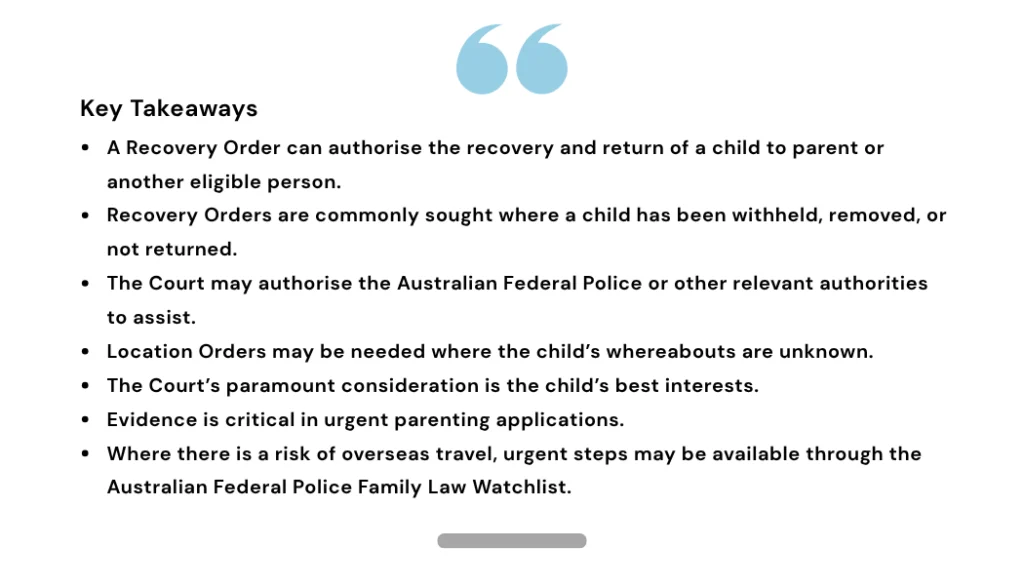
A Recovery Order is an order made by the Federal Circuit and Family Court of Australia that authorises the recovery and return of a child.
Depending on the circumstances, a Recovery Order may direct or authorise certain people or authorities to locate, recover, and return the child to:
- a parent;
- a person with parental responsibility;
- a person who has the right to spend time with, live with, or communicate with the child under a parenting order; or
- another eligible person concerned with the child’s care, welfare, and development.
Recovery Orders may authorise the Australian Federal Police, state police, or other relevant authorities to assist in locating and recovering the child.
These orders are commonly sought where a child has been removed, retained, or withheld without agreement, contrary to parenting arrangements, or in breach of parenting orders.
When Might a Recovery Order Be Needed?
Many parents assume a Recovery Order in Victoria are only relevant in extreme situations. In practice, these applications can arise in a range of parenting disputes and urgent child-related matters.
A Recovery Order may be considered where:
- a parent refuses to return a child after spending time with them;
- a child is taken to an unknown location;
- a parent relocates with the child without agreement or notice;
- existing parenting orders or arrangements are not being followed;
- communication or contact with the child suddenly stops;
- there are concerns that the child may be removed interstate; or
- there are concerns that the child may be taken overseas.
In some circumstances, a Recovery Order may be available even where no final parenting orders have not yet been made.
Every case turns on its own facts. The Court will consider the circumstances of the child, the conduct of the parties, any existing arrangements or orders, and whether urgent intervention is appropriate.
Missing Child vs Withholding a Child
It is important to distinguish between a missing child situation and a withholding of a child situation.
A missing child situation generally arises where the child’s whereabouts are unknown. In these circumstances, urgent steps may be required to locate the child before any recovery can occur.
A withholding of a child situation occurs where a parent or another person intentionally refuses to return the child or refuses to comply with existing parenting arrangements or parenting orders.
Both situations can be serious. However, the legal approach may differ depending on whether the child’s location is known, whether parenting orders exist, and whether there are safety or welfare concerns.
If there is an immediate risk to a child’s safety, emergency services or police involvement may be necessary before, or alongside, any family law application.
What If the Child’s Location Is Unknown?
Where a child’s whereabouts are unknown, the Court may make Location Orders.
A Location Order can require a person, organisation, or government agency to provide information that may assist in locating the child.
Depending on the circumstances, information may be sought from:
- schools;
- government agencies;
- medical providers;
- financial institutions;
- telecommunications providers;
- relatives or other individuals; or
- other parties who may hold relevant information.
Location Orders are often an important first step where a child cannot be found or where one parent is deliberately concealing the child’s location.
Family Law Watchlist and Urgent Travel Restrictions
Where there are concerns that a child may be taken overseas, urgent steps may be available to help prevent international travel.
In appropriate cases, the Court may make orders enabling a child to be placed on the Australian Federal Police Family Law Watchlist. This can assist in preventing a child from being removed from Australia while parenting proceedings are ongoing or while urgent issues are being determined.
These matters are often time-sensitive. Delay may affect the practical options available, particularly where there is a risk that a child may be taken through an airport or across an international border.
What Does the Court Consider?
The Court does not automatically grant a Recovery Order simply because an application is made.
As with all parenting matters, the child’s best interests are the Court’s paramount consideration.
When deciding whether to make a Recovery Order, the Court may consider:
- any existing parenting orders;
- the current parenting arrangements;
- the circumstances surrounding the child’s removal, retention, or withholding;
- whether the child’s location is known;
- whether there are allegations of family violence;
- whether there are safety concerns affecting the child or either parent;
- the child’s current circumstances;
- any potential risk of harm to the child;
- whether the child may be removed interstate or overseas;
- the urgency of the application; and
- whether the proposed orders are necessary and appropriate.
The Court will assess the available evidence before determining whether a Recovery Order should be made.
Why Evidence Matters in Recovery Order Applications
Evidence is critical in urgent parenting applications.
A parent applying for a Recovery Order will usually need to provide clear and accurate information about the relevant events and the orders sought.
This may include evidence about:
- existing parenting orders or parenting arrangements;
- the child’s usual living arrangements;
- when the child was meant to be returned;
- what occurred when the child was not returned;
- communications between the parties;
- attempts made to contact the other parent;
- attempts made to locate the child;
- any safety concerns;
- any concerns about interstate or overseas travel; and
- the urgency of the situation.
Supporting documents may also assist, including:
- text messages;
- emails;
- parenting orders;
- police reports;
- family violence intervention orders;
- medical records;
- school records;
- travel information;
- photographs or screenshots; and
- other relevant communications or documents.
Clear evidence can be particularly important where the application is urgent or where the Court is being asked to make orders without the other party being present.
Can the Court Refuse to Make a Recovery Order?
Yes. The Court may refuse to make a Recovery Order if it is not satisfied that the order is appropriate in the circumstances.
For example, the Court may decline to order the immediate return of a child where there is evidence that returning the child may expose them to a risk of harm, or where significant welfare concerns require further consideration.
The Court may also make different or interim orders depending on the evidence, the level of urgency, and the child’s best interests.
Each case is assessed individually. The Court’s focus remains the child’s safety, welfare, and best interests.
Why Acting Promptly Can Be Important
Parents sometimes hope that a child will be returned after a short period of time. In some cases, the situation may resolve quickly. In others, delay can make the matter more difficult.
Delay may affect:
the ability to locate the child;
the availability of evidence;
the ability to prevent interstate or overseas travel;
the Court’s assessment of urgency; and
the practical steps available to recover the child.
Where a child has not been returned, their location is unknown, or there are concerns about removal from Victoria or Australia, prompt action can be important.
How Shan Lawyers Can Assist
Situations involving the removal, retention, or withholding of a child are among the most stressful family law matters a parent can experience.
Shan Lawyers assists parents across Melbourne and Victoria with urgent parenting matters, including:
- Recovery Orders;
- Location Orders;
- Family Law Watchlist applications;
- urgent parenting applications;
- parenting disputes;
- child safety concerns; and
- matters involving children who have not been returned or cannot be located.
If you are concerned that your child has been withheld, removed, or taken to an unknown location, Shan Lawyers can advise on Recovery Orders in Victoria and other urgent family law options. Contact our Melbourne family law team to discuss your circumstances.
About the Author

Thirumalai Selvi Shanmugam is the founder, Director, and Principal lawyer at Shan Lawyers and is a leading family law specialist in Australia whose expertise is often sought by organisations and the media.
Disclaimer
This article provides general information only and does not constitute legal advice. Family law matters are fact-specific, and available options depend on the circumstances of each case.
Frequently Asked Questions
Who can apply for a Recovery Order?
Depending on the circumstances, an application may be made by a parent, a person with parental responsibility, or another eligible person concerned with the child’s care, welfare, and development.
Does a Recovery Order require existing parenting orders?
Not always. While existing parenting orders can be relevant, a Recovery Order may still be available in some situations where no formal orders are currently in place.
What happens if the child’s location is unknown?
The Court may consider making Location Orders to help identify the child’s whereabouts before further recovery steps are taken.
Can a child be stopped from leaving Australia?
In urgent situations where there are concerns about international removal, steps may be available to help prevent overseas travel while the matter is considered by the Court.